Preparing for IELTS as a working designer — what I learned
How a design workflow (drafts, reviews, iterations) helped me prep for the test.
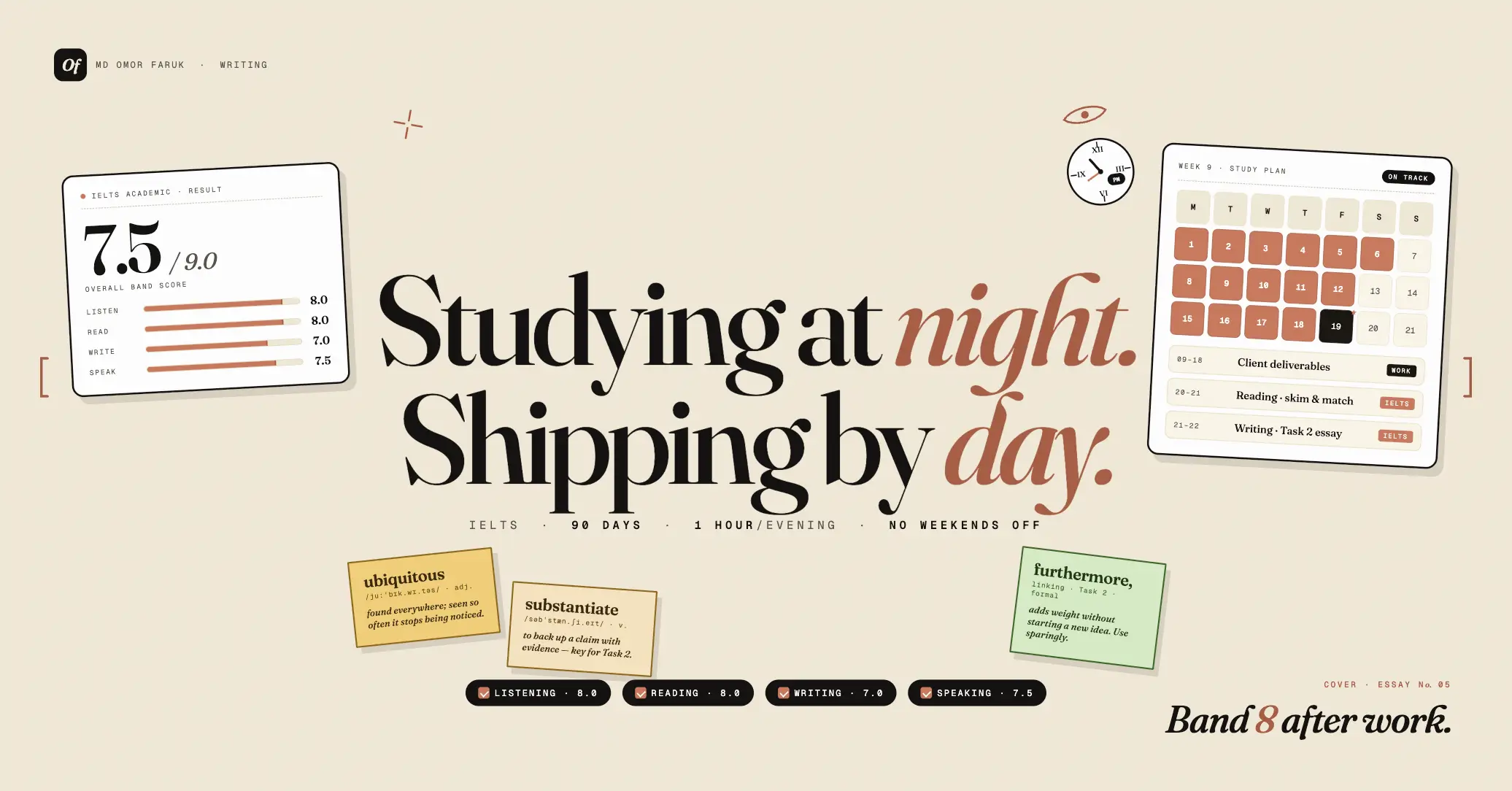
Preparing for IELTS while working full-time as a designer taught me something unexpected: language practice is not separate from design work. In many ways, the habits that make someone better at design—clarity, consistency, observation, and structure—also help with exam preparation. The challenge was not only learning English better. It was learning how to study with discipline after long working days.
At first, I underestimated the difficulty. Because I worked in design, collaborated with English-speaking teams, and regularly read briefs, interfaces, and marketing content in English, I assumed the test would feel natural. But IELTS is not really a casual-use exam. It tests timing, structure, accuracy, and focus under pressure. That is a different skill set.
The biggest lesson I learned was that familiarity with English is not the same as readiness for IELTS. I could understand a lot, communicate at work, and explain design ideas well enough in meetings and messages. But the test required more than that. It required deliberate practice, especially in writing and speaking, where small weaknesses become very visible.
Studying after work is a design problem
The hardest part was not the content. It was energy.
After a full workday, especially when I had spent hours making design decisions, reviewing layouts, or solving communication problems with teams, my brain felt used up. I had to stop pretending I would become a different person at night and suddenly study for four perfect hours. That was unrealistic.
So I started treating IELTS preparation like a design constraint. Instead of building an ideal routine, I built a workable one. Short sessions were better than ambitious plans that collapsed after three days. A focused hour every day helped more than a dramatic weekend schedule I could not sustain.
That changed everything. Once I accepted the limits of my time and attention, I became more consistent.
Writing was harder than I expected
As a designer, I already cared about communication. I thought writing would be one of the easier parts of the exam. In reality, IELTS writing exposed a different kind of weakness: structure under time pressure.
In design work, I often write short, functional things—headlines, labels, notes, feedback, summaries. IELTS asked for something else. It asked me to develop ideas in a formal, controlled way while watching grammar, vocabulary, cohesion, and timing all at once.
What helped me most was learning that good IELTS writing is not about sounding complicated. It is about being clear, direct, and organized. That felt surprisingly close to good UX writing. A sentence should do its job. A paragraph should have one purpose. The reader should never have to guess what I mean.
Once I stopped trying to sound “advanced” and focused on sounding precise, my writing improved.
Speaking improved when I stopped performing
The speaking test made me nervous at first because I thought I needed to sound polished all the time. That pressure made me overthink. I would start a sentence, edit it in my head, and lose fluency.
What I learned was that the examiner is not looking for perfection. They are listening for communication. Can I answer clearly? Can I extend an idea? Can I handle follow-up questions without falling apart?
That realization helped me relax. I practiced speaking the way I explain design choices: calmly, clearly, and with examples. Instead of memorizing impressive phrases, I practiced organizing thoughts quickly. That made my answers more natural and easier to sustain.
The biggest improvement came when I recorded myself. It was uncomfortable, but useful. I could hear repetition, hesitation, and weak transitions much more clearly than I could notice them while speaking.
Listening and reading rewarded habits I already had
Listening and reading felt more familiar because design work had already trained some useful instincts. Designers scan for patterns, compare options, and pay attention to small details that change meaning. Those habits helped in both sections.
But there was still a trap: confidence. In reading especially, it is easy to move too fast because you think you understood the text. IELTS punishes that kind of overconfidence. I had to learn to read with precision, not just speed.
The same thing happened in listening. Missing one word can affect several answers. I learned to keep moving instead of mentally freezing over a missed detail. Recovery mattered more than perfection.
Progress came from repetition, not intensity
One of the most useful things I learned was that improvement rarely felt dramatic. It was not a sudden breakthrough. It was repetition.
Doing practice tests helped, but reviewing mistakes helped more. I had to understand why an answer was wrong, why a sentence sounded weak, or why a speaking response became awkward in the middle. That reflection mattered more than simply doing more questions.
As a designer, I am used to iteration. IELTS preparation responded to the same mindset:
- try
- review
- adjust
- repeat
That made the process less emotional. A weak performance on one day did not mean I was failing. It was just feedback.
Working full-time forced me to study smarter
Being employed while preparing for IELTS was difficult, but it also made me more efficient. I had less time, so I wasted less of it. I became more selective about what actually worked for me.
I learned that not every resource is equally useful. Some materials looked helpful but were too broad or too passive. I needed practice that resembled the real test and feedback that showed me exactly where I was losing marks.
I also learned that consistency beats motivation. On many days, I did not feel excited to study. I studied anyway, even if the session was short. That mattered more than waiting for the perfect mood.
What I would tell other working professionals
If you are preparing for IELTS while working full-time, especially in a field like design, do not assume your professional English will automatically carry you through. It helps, but it is not the whole exam.
Also, do not underestimate how tiring it is to prepare seriously while managing deadlines and responsibilities. Make the plan smaller, not grander. Build a routine you can repeat even on busy days.
Most importantly, do not confuse struggle with lack of ability. Sometimes you are not doing badly—you are just tired, stretched, and learning under pressure.
What stayed with me
Looking back, IELTS preparation taught me more than test strategy. It reminded me that communication is a skill you keep sharpening. It also reminded me that discipline matters more than self-image. It did not matter whether I thought of myself as “good at English.” What mattered was whether I practiced the specific skills the exam required.
As a working designer, that was the real lesson. Progress came from structure, repetition, and honest review—the same things that improve design work over time.
Preparing for IELTS while working was not easy. But it made me more patient, more methodical, and more aware of how I communicate. In that sense, the exam was not separate from my professional life at all. It became another way of learning how to be clear.