Lessons from 3 years of full-time remote design for US clients
What I got wrong, what worked, and the rituals that kept a US–Bangladesh team shipping.
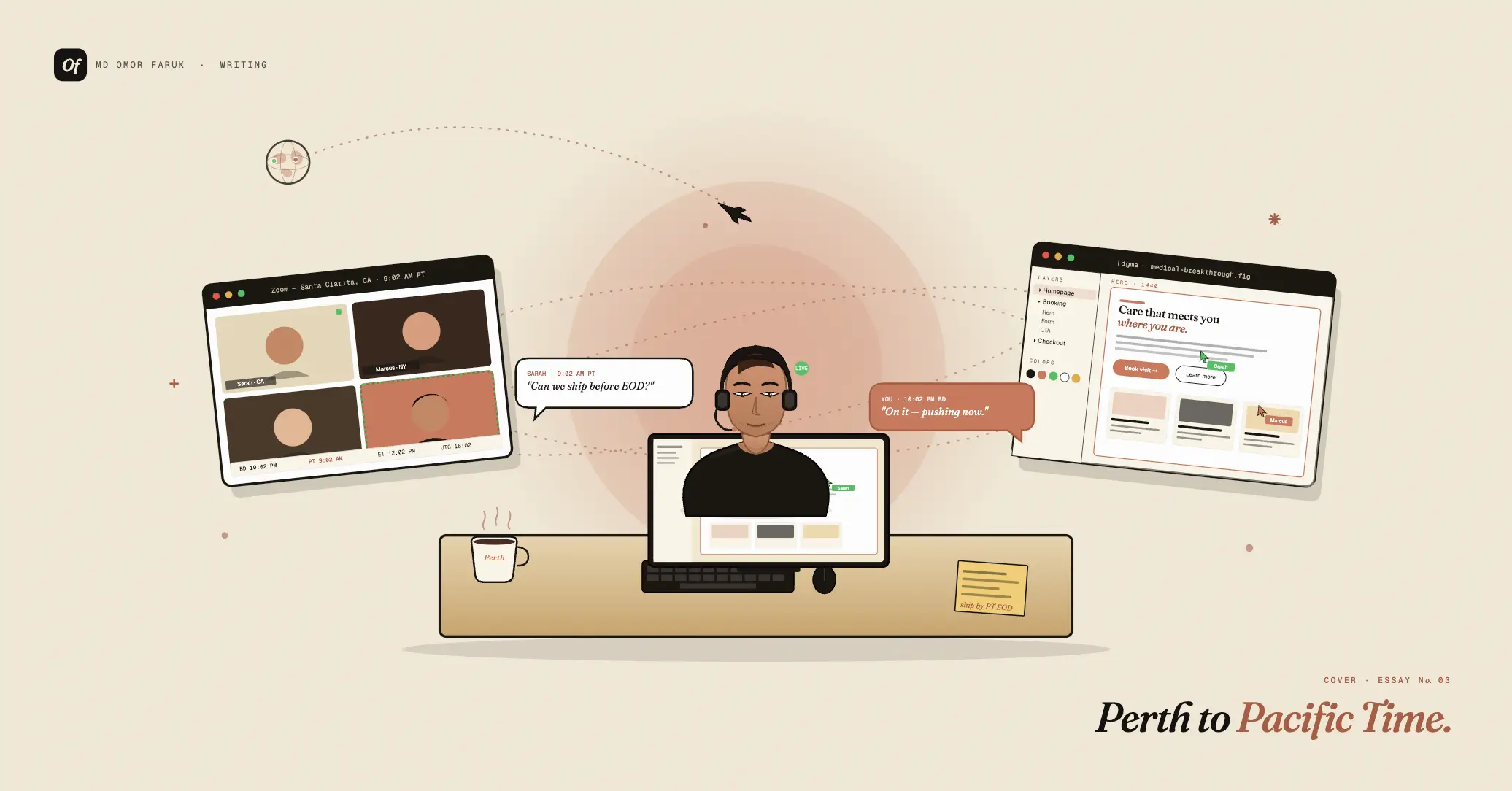
Working full-time as a remote designer for US clients taught me far more than how to make better screens. It taught me how to communicate without relying on proximity, how to make decisions visible, how to work across time zones without losing momentum, and how to build trust with people who may never meet me in person. Over three years, I learned that remote design is not just design done from home. It is a different discipline altogether.
At the beginning, I thought the hardest part would be the design work itself. I assumed the real challenge would be keeping up with expectations, delivering polished interfaces, and adapting to international standards. Those things mattered, of course. But the deeper lessons came from the invisible parts of the job: clarity, ownership, responsiveness, and the ability to reduce confusion before it slows a team down.
Remote work, especially with clients in another country, makes small weaknesses very visible. If your communication is vague, people notice. If your files are messy, people notice. If your thinking is not structured, people notice. Over time, that pressure made me better.
Design is only half the job
One of the first things I learned is that being a strong designer is not enough. In a remote environment, your work has to speak clearly even when you are not in the room to explain it.
That changed the way I present ideas. I became more careful with file organization, annotations, naming systems, and design rationale. Instead of assuming I could clarify something later in a live conversation, I learned to make my thinking visible from the start.
A good mockup is helpful. A good mockup with clear reasoning is much more powerful.
That shift improved not only collaboration, but also the quality of my own decisions. When I had to explain why I chose a layout, a hierarchy, or a flow, weak thinking became easier to catch. Remote work forced me to become more deliberate.
Communication beats speed
At first, I believed being fast would be my biggest advantage. Later, I realized that reliability matters more than raw speed.
Clients do appreciate quick delivery, but what they value more is predictability. They want to know that deadlines will be respected, updates will arrive on time, and problems will be surfaced early instead of hidden. A designer who communicates clearly can reduce more stress than a designer who simply works fast in silence.
This was one of the biggest professional lessons I learned. Good remote communication is not about writing more. It is about writing better. A short update can be enough if it answers the questions people already have:
What is done? What is still in progress? What needs feedback? What is blocked? What happens next?
When those things are clear, collaboration becomes much smoother.
Time zones teach ownership
Working with US clients from a different time zone taught me how to work more independently. I could not rely on instant clarification all the time. Sometimes feedback arrived late in my evening. Sometimes questions had to wait until the next day. That forced me to improve the quality of my own judgment.
I learned to anticipate issues before they became blockers. I learned to package design work in ways that made review easier. I learned to leave fewer loose ends.
In many ways, time zone difference became a teacher. It pushed me to become more proactive, more organized, and less dependent on constant back-and-forth. That kind of ownership is valuable in any role, but remote work makes it essential.
“When you work across time zones, clarity becomes a form of momentum.”
The more clearly you communicate, the less likely the work is to stall.
Feedback feels different when it is mostly written
Another lesson I learned is that remote feedback has a different texture. In an office, tone can be softened by facial expression, quick discussion, or casual conversation. In remote work, feedback often arrives as comments, messages, or short calls. That can make it feel sharper than it actually is.
Over time, I learned not to overreact to brevity. A short message is not necessarily cold. A direct comment is not necessarily disrespectful. In distributed teams, people are often just trying to move efficiently.
That lesson helped me become more professional. I became better at separating ego from iteration. Instead of reading feedback emotionally, I tried to read it structurally: what problem is being pointed out, what outcome is being requested, and what can be improved?
That mindset made revision faster and collaboration healthier.
Trust is built through small consistencies
One of the most important things remote work taught me is that trust is rarely built through one dramatic moment. It grows through repeated small signals.
Deliver when you say you will. Respond when you said you would. Ask smart questions early. Flag uncertainty before it becomes a problem. Make handoff easy for developers and stakeholders. Stay calm when priorities change.
These things may not look impressive in a portfolio, but they matter enormously in client relationships. Over time, clients stop seeing you as someone who “makes screens” and start seeing you as someone they can depend on.
That shift changes the kind of work you get. More trust usually leads to more responsibility, more autonomy, and more meaningful collaboration.
Good design has to survive async work
Remote work also taught me a very practical truth: if a design only makes sense when I am there to explain it live, it is probably not clear enough yet.
That realization changed the way I approach interfaces. I now think more carefully about whether a decision is self-evident, whether a user flow is truly intuitive, and whether the hierarchy is doing enough work on its own. I also became more aware of how design files function as communication tools for teammates, not just visual outputs.
In async environments, the work must travel well. It moves between designers, marketers, developers, managers, and clients. If it creates confusion at every handoff, that is not only a workflow problem. It is a design problem.
Cultural differences made me more careful
Working with US clients also sharpened my awareness of audience, tone, and expectation. Some communication styles felt more direct than what I was used to. Some design decisions prioritized business clarity over visual flourish. Some meetings moved faster than expected, with an emphasis on action rather than extended discussion.
Instead of seeing those differences as obstacles, I gradually learned to treat them as context. Every team has its own rhythm, language, and decision-making style. Remote work taught me to observe those patterns early and adapt without losing my own strengths.
That made me a better collaborator. It also made me a better designer, because design itself is always shaped by context.
Remote work requires boundaries too
Not all the lessons were about productivity. Some were about sustainability.
Working remotely can blur the line between being available and always being on. When the team is in another country, it becomes easy to stretch your day, check messages too late, or feel that you should always respond immediately. For a while, I treated that as professionalism. Later, I understood that it can quietly damage both focus and health.
I learned that good remote work needs boundaries. Not rigid distance, but healthy structure. Clear working hours, organized communication, and realistic expectations protect the quality of the work itself. A tired designer may still produce output, but not always good judgment.
That lesson took time to learn, and I think it is one of the most important.
What three years changed in me
After three years of full-time remote design for US clients, I can say the experience changed more than my workflow. It changed my standards.
I became more disciplined about communication. More thoughtful about documentation. More independent in decision-making. More aware of trust, timing, and collaboration. And more convinced that design is as much about reducing confusion inside teams as it is about reducing confusion for users.
Remote work did not make things easier. It made certain weaknesses harder to hide. But that is exactly why it helped me grow.
What stays with me
Looking back, the biggest lesson is simple: remote design is not only about talent. It is about clarity, consistency, and professional maturity.
You can be visually strong and still struggle remotely if your communication is weak. You can be technically capable and still slow a project down if you do not create alignment. On the other hand, when you combine design skill with reliability and thoughtful communication, distance becomes much less of a barrier.
That is what three years of remote work taught me. The real job was never just making good interfaces for US clients. It was learning how to make good work understandable, dependable, and easy to move forward—across screens, across teams, and across time zones.